

How to Use AI for Writing Content
Since ChatGPT came on the scene in November 2022 there’s been an explosion of artificial intelligence or AI technologies that have come out as well. While it was certainly not the first large language model (LLM) to come online, it made the biggest splash. After its release, it seemed like everyone and their boss was talking about using AI to create content.
The reality is, using AI for writing content can in fact help you get your work done faster. But, like all things in content and marketing, there’s a right way and a wrong way to go about using writing software to get your content written. With that in mind, we thought we’d share our thoughts on the right way to use AI to write your blog posts, podcast show notes, social media posts, and so much more.
The Benefits of Using AI for Writing Content
One of the biggest benefits of using AI writing tools is a significant boost in efficiency and productivity. Leveraging AI to assist with various stages of the content creation process, from brainstorming ideas to drafting articles and polishing your writing, can dramatically reduce the time and effort required to produce high-quality content. This is especially valuable for businesses and individuals who need to create a high volume of content on a regular basis, as it allows you to streamline your workflow and get more done in less time.
Another key benefit is that AI can help improve the quality and effectiveness of your content. Many AI writing tools are designed to optimize your content for search engines, suggesting relevant keywords, headings, and structures that can boost your rankings and drive more organic traffic to your site. They can also help ensure your content is grammatically correct, easy to read, and engaging for your target audience. Additionally, AI can provide data-driven insights and recommendations based on the performance of your existing content, enabling you to continually refine your approach and create content that resonates with your readers.
Related: Check out our post featuring 7 real-world examples of using AI in marketing.
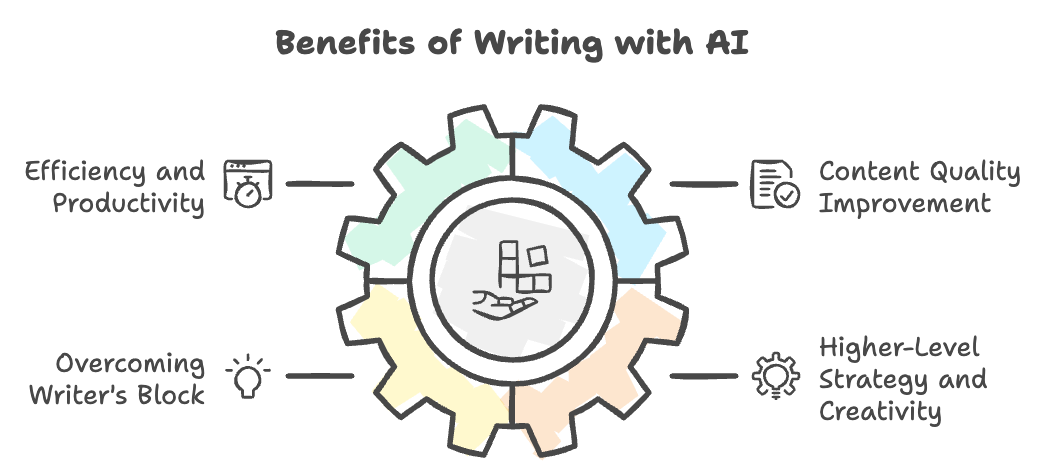
AI writing assistants can also help overcome writer's block and spark new ideas when you're feeling stuck. By suggesting topics to write about, generating outlines, and even producing entire paragraphs based on your input, these tools can jumpstart your creative process and help you approach your content from fresh angles. This can be particularly useful when you need to produce a large amount of content on a tight deadline, as it allows you to quickly generate a solid first draft that you can then refine and polish.
Perhaps most importantly, AI writing tools can free you up to focus on higher-level strategy and creativity. By handling much of the time-consuming research, outlining, and drafting process, these tools allow you to devote more of your energy to big-picture planning, innovative ideas, and the unique insights that only a human can provide. In essence, AI can serve as a powerful assistant that enhances your own skills and expertise, ultimately enabling you to produce better content in less time. As these technologies continue to advance, they'll likely play an increasingly pivotal role in the world of content creation.
Limitations of Using AI for Writing Content
There are of course limitations for using AI technology to produce written content. Regardless of the tool you choose, it’s important to understand it may struggle with complex or nuanced topics that require deep expertise or emotional intelligence. Furthermore, AI tools can produce generic or repetitive content if not properly guided or customized.
It’s also worth noting that AI tools may not always capture the unique voice or style of a brand or individual writer. To make matters worse, they can sometimes make up information like data, source material, and even weblinks and present them as fact.
As a result, whatever tool you’re using will require human oversight and editing to ensure quality and accuracy. In other words, it’s never a good idea to put a prompt into a tool, and publish the response as is.
Understanding AI Writing Tools
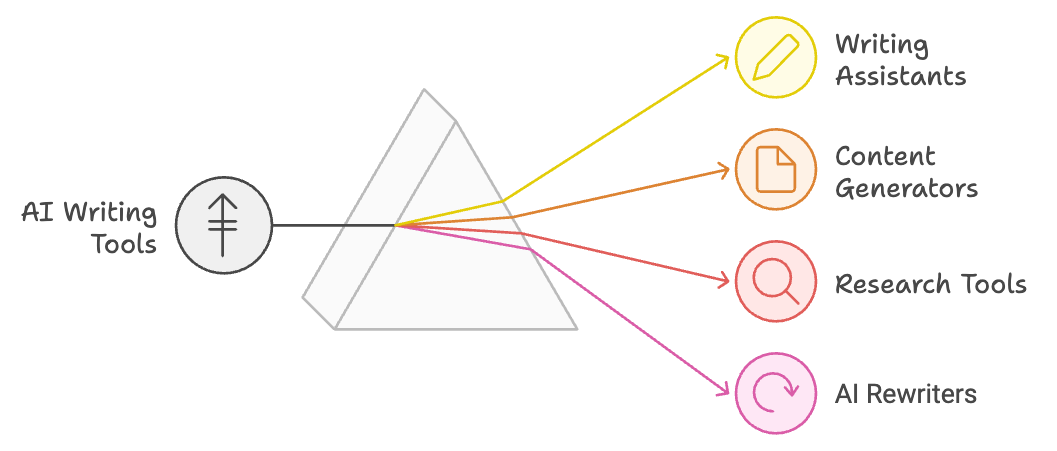
There are four main types of AI writing tools available:
1. AI writing assistants: These tools work alongside human writers, offering suggestions, improvements, and editing assistance to enhance the writing process. Examples include Grammarly, Hemingway, and ProWritingAid.
2. AI content generators: These tools use natural language processing (NLP) and machine learning algorithms to generate original content based on user input, such as keywords, topics, or prompts. Examples include GPT-3, Writesonic, and Article Forge.
3. AI-powered research tools: These tools help writers gather and analyze data, conduct research, and uncover insights to inform their content. Examples include Frase, Clearscope, and MarketMuse.
4. AI rewriters: These tools can help you rewrite text automatically. You upload or copy and paste a document, and the writing software rewrites it to pass a plagiarism checker as original content.
How AI writing tools work
AI writing tools rely on advanced algorithms, NLP, and machine learning to understand and generate human-like text. They are trained on vast amounts of data, allowing them to recognize patterns, understand context, and produce coherent, relevant content.
Choosing the Right AI Writing Tool
There are a few factors to consider when selecting an AI writing tool. These include, but aren’t limited to:
– Your specific writing needs
Consider the type of content you create, your target audience, and your overall goals to select a tool that aligns with your requirements.
– Ease of use and learning curve
Look for tools with intuitive interfaces and clear documentation to minimize the time and effort needed to get started.
– Integration with other tools
Consider how well the AI writing tool integrates with your existing content creation workflow, such as your preferred word processor, content management system, or SEO tools.
– Cost and pricing structure
Evaluate the cost of the tool in relation to your budget and the value it provides. Some tools offer free plans or trials, while others require a subscription or pay-per-use model. Keep an eye out for phrases like unlimited words, long form, and prompt limitations when shopping for AI content writing software.
Read reviews and test free trials whenever possible to see how the writing software you are considering purchasing works. It's best to ensure it will do what you want it to before you make a commitment.
Integrating AI into Your Writing Process

There are basically four ways you can integrate AI into your writing process - brainstorming and idea generation, research and data gathering, generating the content for you, and editing and refining AI-generated content.
Brainstorming and idea generation with AI
AI writing tools can be incredibly valuable during the brainstorming and idea generation phase of your writing process. These tools can help you quickly generate a wide range of ideas, angles, and perspectives on your chosen topic, providing inspiration and direction for your content. By inputting key phrases or themes related to your subject matter, you can use AI to uncover related subtopics, questions, and insights that you may not have considered on your own. This can be especially useful when you're feeling stuck or looking for fresh ways to approach a well-worn topic. Additionally, AI can analyze your existing content and suggest new ideas that align with your brand voice and audience interests.
Using AI for research and data gathering
Another powerful way to integrate AI into your writing process is by leveraging AI-powered research tools. These tools can quickly gather relevant data, statistics, case studies, and expert insights on your topic, providing a solid foundation of facts and context for your content. By using AI to automate much of the time-consuming research process, you can focus your energy on analyzing and interpreting the information, rather than spending hours scouring the web for credible sources. Some AI research tools can even summarize key points from lengthy articles or reports, making it easier to distill complex information into digestible insights for your readers.
Crafting content with AI writing assistants
AI writing assistants can be game-changers when it comes to the actual content creation process. These tools can help you draft clear, compelling, and error-free content more quickly and easily than ever before. By providing real-time suggestions for grammar, syntax, and word choice, AI writing assistants can help you refine your writing as you go, ensuring that your content is polished and professional. Some tools even offer suggestions for alternative phrasing or sentence structures, helping you find the most effective way to communicate your ideas. Additionally, AI writing assistants can help ensure consistency in your brand voice and style across all your content.
Editing and refining AI-generated content
Finally, AI content generators can be powerful tools for producing high-quality content at scale – but it's important to approach them with a discerning eye. When using these tools, always take the time to carefully review, edit, and refine the AI-generated output to ensure that it meets your high standards for accuracy, clarity, and brand alignment. While AI can produce impressive results, it's not perfect – it may sometimes generate content that is irrelevant, inconsistent, or factually incorrect. By carefully editing and refining AI-generated content, you can harness the efficiency of these tools while still maintaining full control over your final output.
Best Practices for Using AI in Writing
As we said earlier, you should never take a response from a prompt and publish it as is. With that in mind, here are some of the best practices for using AI in your writing process:
– Maintain a human touch in your content: While AI tools can assist in the writing process, it's essential to maintain a human touch in your content. Infuse your unique perspective, experiences, and insights to create content that resonates with your audience.
– Use AI as a tool, not a complete replacement for human writers: AI should be viewed as a tool to enhance human writing, not a complete replacement for human creativity and expertise. Collaborate with AI to achieve the best results, but don't rely on it exclusively.
– Proofread and edit AI-generated content: Always proofread and edit content generated by AI tools to catch any errors, inconsistencies, or irrelevant information. Human oversight is crucial to maintaining quality and accuracy.
– Ensure the accuracy and credibility of AI-generated information: Verify the accuracy and credibility of any information or data generated by AI tools. Fact-check and cross-reference with reliable sources to maintain the integrity of your content. This is especially important if there are statistics, weblinks, and other critical information in your content.
– Always use a plagiarism checker to ensure that your writing assistant or AI content generator didn't simply give you someone else's work. The last thing you want is to post someone's content as your own!
– Avoid over-reliance on AI tools: While AI tools can be powerful aids in the writing process, avoid becoming overly dependent on them. Continue to develop your own writing skills and maintain a balance between human creativity and AI assistance.
Our Prediction of The Future of AI in Writing
As AI technologies continue to evolve, we can expect to see more sophisticated writing tools that offer greater accuracy, flexibility, and customization. These tools may be able to better understand context, adapt to individual writing styles, and generate more nuanced and creative content.
Potential impact on the writing and content creation industry
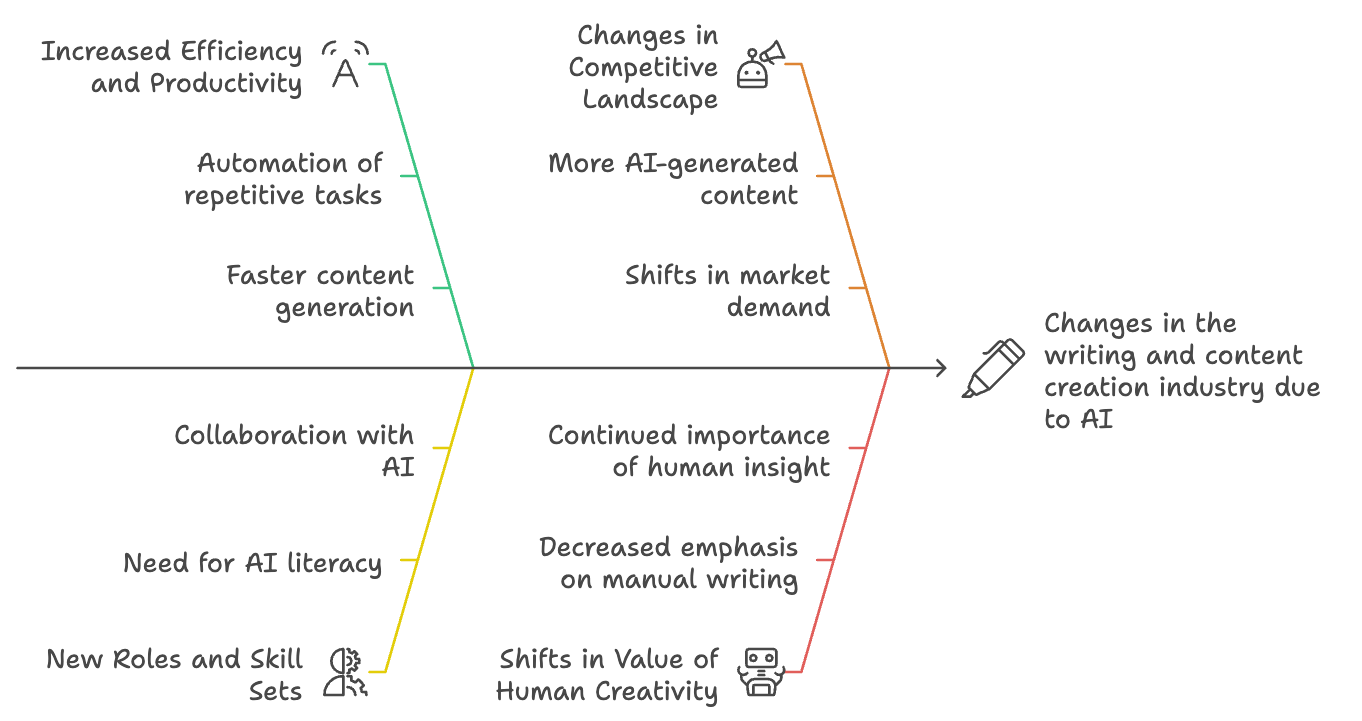
The growing use of AI in writing and content creation may lead to significant changes in the industry, including:
- Increased efficiency and productivity for writers and content creators
- New roles and skill sets required to effectively collaborate with AI tools
- Changes in the competitive landscape as AI-assisted content becomes more prevalent
- Potential shifts in the value placed on human creativity and expertise in writing.
As AI continues to shape the future of writing and content creation, it's essential for writers and content creators to stay informed, adapt to new tools and techniques, and find ways to leverage AI to enhance their work while maintaining the unique value of human creativity and insight.
We don’t see it going away. In fact, we see it growing and becoming more and more prevalent in virtually every industry you can think of.
Using Your Own Voice to Generate AI Content with Tools Like Castmagic
Did you know that you can create content from your own words using a tool like Castmagic? In an era where people are producing content that feels like a copy of a copy of a copy, generating content based on your own stories and lived experiences can help set you apart from the competition.
Call us biased if you like, but we consider our platform to be the best AI writer on the market!
How Castmagic works
You simply upload your audio file (podcast episode, voice recording, etc.), and Castmagic transcribes the audio. Then, using your transcription you can generate a wide variety of content assets up to and including:
- Show notes, titles, and keywords for podcasts
- Blog posts and articles
- Social media posts, captions and tweet threads
- Quotes, highlights and video clip scripts (great for creating content on YouTube!)
- Email newsletters and follow-up sequences
Benefits of generating content from your own audio
- It's your own words and ideas being used to create the content
- Helps ensure the content reflects your unique voice, personality and expertise
- Can feel more authentic and on-brand compared to purely AI-generated text
- Saves time by automating content creation based on something you've already said
Using AI-powered tools like Castmagic to generate content assets from your own spoken words is an innovative way to create on-brand content more efficiently. Since the source material is your own audio recordings, you can feel confident the resulting content will align with your voice and perspectives. Repurposing podcast episodes, meetings, coaching sessions and other recordings into written content enables you to get more value out of the time you've already invested. While AI handles the time-consuming transcription and content generation, you're freed up to focus on higher-level tasks.
Is It Time to Try Using AI Tools to Write Content?

Leveraging AI tools to streamline your content creation process is no longer a luxury – it's a necessity. As these technologies continue to advance, they offer an unparalleled opportunity to boost your productivity, improve content quality, and free up valuable time for high-level strategic thinking.
By integrating AI into your writing workflow, you can generate ideas, conduct research, draft content, and refine your work more efficiently than ever before. Whether you're a busy entrepreneur, a content marketer, or a creative professional, AI writing tools can help you stay ahead of the curve and deliver compelling, engaging content that resonates with your target audience.
So, is it time to try using AI tools to write content? The answer is a resounding yes! And there's no better place to start than with Castmagic.
With Castmagic, you can harness the power of AI to generate high-quality content assets from your own voice recordings. Simply upload your podcast episodes, YouTube videos, voice notes, or other audio files, and let Castmagic's advanced AI technology do the rest. From show notes and blog posts to social media captions and email newsletters, Castmagic can help you repurpose your spoken content into a wide range of written formats – all while maintaining your unique voice and perspective.
Best of all, you can try Castmagic for free. So why wait? Sign up today and start generating authentic, on-brand content from your own words. With Castmagic, you'll save time, boost your productivity, and take your content creation game to the next level. Don't miss out on this game-changing opportunity – try Castmagic now and experience the power of AI-driven content creation for yourself!
More blogs like this

How to Clip a YouTube Video: Easy Guide for Snippets
Luckily, sometimes you don't need the whole ocean. You just need a single drop, a perfect moment, a snippet that captures exactly what you want to share. Whether it's a hilarious reaction from your favorite creator's livestream, an insightful tip buried in a hour-long tutorial, or a game-changing moment you want to share across your social media channels, learning how to clip a YouTube video is an essential skill for anyone creating or sharing content.

How to Use AI Podcast Show Notes to Grow Your Show
What should take 30 minutes somehow stretches into two hours as you struggle to capture the essence of your conversation, identify key timestamps, and craft something that will actually help people discover your show. Sound familiar? Here's the thing though, search engines can't listen to your audio content. They rely entirely on text to understand what your episodes are about.

ChatGPT Alternatives: Best Free AI Tools for 2026
Whether you're a content creator needing specialized writing assistance, a developer seeking coding support, or a researcher requiring current data with proper citations, there's an AI chatbot perfectly suited to your needs. In this guide, we're looking at the top AI tools available in 2026, examining their standout features, and helping you discover which ChatGPT alternative will transform how you work.

Best Podcast Name Generator: Great Podcast Name Ideas
In this guide, we'll explore how to leverage podcast name generators effectively, combine them with creative strategies, and land on podcast name ideas that resonate with your audience and stand out in crowded directories. Among the many tools available, Castmagic stands out as the best podcast name generator for both your overall show title and individual episode names.

Best Generative AI Platforms: Features That Set Them Apart (And Why Castmagic Leads for Content Creators)
In this guide, we're exploring what truly separates exceptional platforms from adequate ones, examining the features that matter most, and equipping you with the knowledge to use AI effectively for your specific needs. And if you're a content creator, podcaster, YouTuber, or marketer working with audio and video, you'll discover why Castmagic has emerged as the superior choice.
Descript Pricing (2026): Every Plan, What's Actually Free, and Is It Worth It?
Descript pricing explained: the free plan's real limits, what Hobbyist, Creator and Business cost monthly vs annually, AI credits, and whether it's worth it for you.

Best Podcast Transcription Services Worth Trying Today
When you transcribe your podcast episodes, you're essentially creating a treasure trove of keyword-rich content that can boost your online visibility exponentially. Plus, you're opening your show to audiences who prefer reading over listening, not to mention those who are deaf or hard of hearing. But, we get it: manually transcribing your own podcast is brutal. That's time you could spend creating better content, connecting with your audience, or actually growing your show! The best podcast transcription services save you from this drudgery while delivering accurate, usable transcripts that work for your workflow and budget.

Top 7 Best Speech to Text Apps for Accurate Transcription
In this comprehensive guide, we'll walk you through the top seven apps that transcribe speech to text with remarkable precision. We'll explore what makes each dictation app stand out and how you can choose the perfect voice typing solution for your specific needs.
6 Best Otter.ai Alternatives in 2026 (Free and Paid)
Looking for an Otter.ai alternative? Here are the 6 best, sorted by the job you actually need done: live meeting notes, transcribing recordings, or turning a recording into finished content.